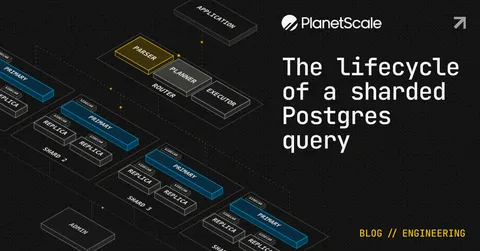
Impressivly good written post about Postgres, Query Planning and database sharding
planetscale.com
The lifecycle of a sharded Postgres query — PlanetScale
Follow a SQL query through the router, across four Postgres shards, and back.
Living document
A living log of articles, talks and papers on agentic engineering — each with a short note on why it is worth your time. Newest first, updated whenever I read something worth passing on.
12 readings · updated
Impressivly good written post about Postgres, Query Planning and database sharding
planetscale.com
Follow a SQL query through the router, across four Postgres shards, and back.
Using the package registries as common ground between OS maintainer and OS user to require payment and transfer them to the OS maintainer. Could work
seldo.com
Thirty years of voluntary funding schemes haven't paid open source maintainers because asking doesn't scale. The real money already flows — to JFrog, Docker, Sonatype — at the registry layer. The fix: registries charge companies for supply (they already do), then route a slice automatically to the maintainers who make that supply worth having.
Mostly focusses on metrics of the projects they are working on and how AI Software factories affects them in a bad way. Interesting in general, but in these argumentations the actual "product" comes to short. Only a short glimpse ala "we had 3 incidents"
X (formerly Twitter)
Why Software Factories Fail
Interesting approach for designing a harness with loading tools on demand based on skills, instead of preloading all tools upfront. Very good read!
linear.app
The product and engineering decisions we made so Linear Agent can handle complex tasks without becoming unpredictable.

Still struggling to translate this into a real loop for my use cases, since the system seems too nondeterministic and requires human interaction to complete a task.
X (formerly Twitter)
7 rules for self-improving agent loops every AI engineer should know
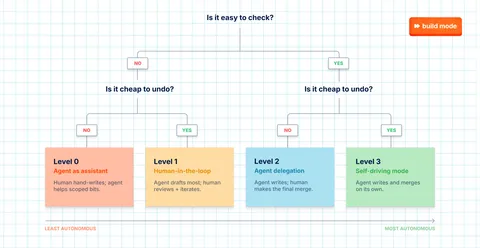
Very good decision tree for guiding if & how much a task should be taken over by AI
X (formerly Twitter)
How much can you delegate to agents?
Based on the em-dashes and writing style, most of it is AI generated but its not as bad as I thought. Although nothing really know if you are somewhat up to date with agentic Engineering in general
walkinglabs.github.io
A project-based course on designing the environments, state, verification, and control systems that make Codex and Claude Code reliable.
While more constraints usually means better results (correctness, code quality), the article argues about adjusting the constaints to your actual throughput. E.g. if Back-pressure is too high by agents creating too many human-review-needed tasks, create more constraints to reduce that effort. If too less back pressure, reduce the required quality gates of the agentic setup
X (formerly Twitter)
Agentic Code Quality

Incredible deep and technical explanation of building a knowledge base without forcing the org to use "only this new tool". Especially the slack part shares what challenges there are to convert slack conversations in a meaningful searching-ground for context
cerebras.ai
See how Cerebras built an enterprise AI knowledge base that connects Slack, code repositories, documentation, and custom data sources.
Must-Read to broaden your perspective. While I agree on the statement "code is not the hard part", I still think the arguments the author makes about the required craft for building the foundation of a successful product is as relevant as ever
Senko Rašić
The software development profession is in the midst of upheaval. Nobody knows how the AI revolution will play out in the end, but it is c...

Perspectives about adding verification capabilities to coding agents for FE changes and how to reduce bottlenecks on long CI jobs. The latter one applies to bigger organizations/ tech-stacks than I work in 😕
X (formerly Twitter)
10,000 PRs a month is easy: How devex is evolving at PostHog

“Code was never the problem.” I’ve been trying to emphasize this for years and couldn’t agree more. Loops help close the gaps for tasks that require real engineering work, rather than simply following a standard procedure.
posthog.com
We're bullish on loops. Here's what they are, why they're taking off now, and what they mean for product engineers.